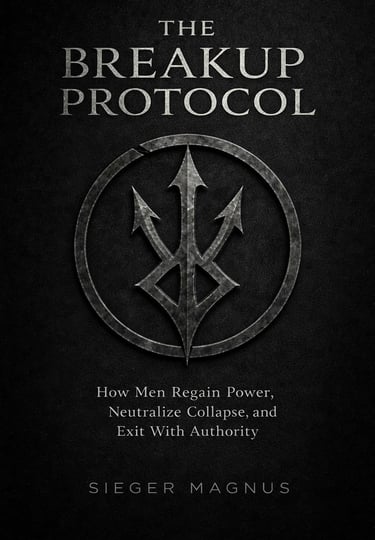
THE BREAKUP PROTOCOL
Severance Without Identity Erosion
Relational loss destabilizes structure faster than almost any external event.
Not because attachment is weakness —
but because attachment rewires priority.
Attention narrows.
Emotion intensifies.
Routine fractures.
Authority weakens.
When loss occurs, internal command is often transferred outward.
The Breakup Protocol prevents that transfer.
It restores hierarchy after severance.
THE STRUCTURAL DAMAGE OF ATTACHMENT
Attachment becomes destabilizing when it shifts authority.
When one person becomes central to:
Emotional validation
Daily routine
Future projection
Identity reinforcement
removal creates vacuum.
Vacuum produces rumination.
Rumination reopens closed decisions.
Reopened decisions weaken authority.
The Breakup Protocol closes the loop decisively.
SEVERANCE AS STRUCTURE
Severance is not emotional suppression.
It is structural disengagement.
This includes:
Communication termination
Environmental separation
Digital disconnection
Physical trigger removal
Partial severance prolongs instability.
Complete severance accelerates recovery.
Lingering contact feeds rumination.
The Protocol eliminates ambiguity.
LOOP TERMINATION
Rumination is unauthorized repetition.
Thought cycles persist because closure was emotional, not structural.
The Breakup Protocol installs:
Final internal directive
No reinterpretation rule
No hypothetical analysis
No narrative reconstruction
Closure is final.
Revisiting is disallowed.
Authority strengthens through enforced finality.
ATTENTION RELOCATION
Attention is finite.
After loss, it becomes fixated.
Fixation weakens performance in other domains.
The Breakup Protocol requires:
Immediate reallocation to training
Increased workload
Scheduled physical exertion
Structured social exposure
Attention must be redirected deliberately.
Unmanaged attention sustains attachment.
IDENTITY REINFORCEMENT
Many relationships subtly merge identity.
After severance, individuals experience identity contraction.
The Protocol counters this by reinforcing:
Personal standards
Structured routine
Defined long-term objectives
Independent action cycles
Identity must stand independent of attachment.
If identity depended on validation, structure must be rebuilt.
EMOTIONAL REASSIGNMENT
Emotion will surge.
It must not command.
The Breakup Protocol does not deny emotion.
It categorizes it.
Emotion becomes signal, not directive.
Signal is observed.
Directive remains internal authority.
This prevents emotional escalation into impulsive action.
DIGNITY PRESERVATION
Post-breakup instability often produces:
Emotional exposure
Reactive messaging
Pleading
Over explanation
These behaviors erode authority.
The Protocol enforces:
Silence
Non-reactivity
Minimal disclosure
Controlled response (if legally necessary)
Dignity strengthens internal stability.
Instability invites regret.
WHO THIS IS FOR
The Breakup Protocol is for the individual who:
Cannot stop thinking about the separation
Feels destabilized in routine
Experiences emotional spikes
Is tempted to reinitiate contact impulsively
It is not reconciliation strategy.
It is structural restoration.
POSITION IN STABILIZATION
Control Systems regulates.
Command Protocol enforces.
Physical Supremacy anchors.
The Breakup Protocol restores when attachment fractures all three.
It prevents emotional destabilization from cascading into identity collapse.
Severance must strengthen authority, not weaken it.
RESULT
When installed:
Rumination decreases
Emotional spikes shorten
Routine stabilizes
Attention re-centers
Authority returns
Loss becomes event, not identity.
Attachment becomes memory, not command.
Stability is restored.